
On the presumption of expertise
It's intoxicating to act like you have all the answers—but is it responsible?

I feel like I can’t go on social media anymore without being told I’m living my life wrong or should give up on my hopes and dreams.
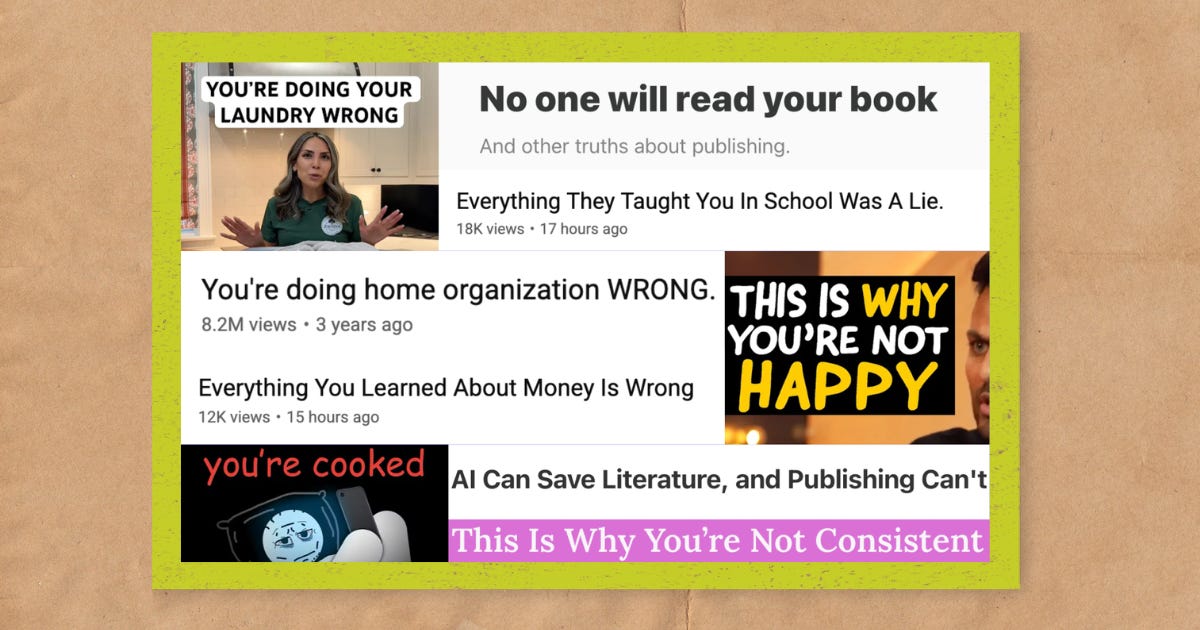
Shouting, weirdly accusatory diagnoses abound within every other YouTube thumbnail or Substack title:
This is why you’re unhappy.
Your Skincare Routine Isn’t Working. Here’s Why.
You’re doing your laundry WRONG
This is the death of the publishing industry.
You Don’t Want Love—You Want to Feel Worthy
Posts like these irritate me even more than the problematically sensationalistic headlines we see in the news, where at least I can feel bad about real things, like skyrocketing rent or a body found in a river. My frustration, I’ve learned after plenty of pondering and angrily scrolling away, is with the presumption of expertise—the arrogance that is required for one person to make a sweeping conclusion about their entire audience, then claim they have the solution to everybody’s problem.
I’m not sure why this phenomenon surprises me. Every day, people spout nonsense on the internet despite having no business doing so, whether it involves diagnosing strangers with mental illnesses on Twitter or a cis dude telling a literal gynecologist that she’s using the incorrect term for female anatomy. The relative anonymity of the internet—and the limited consequences for pissing someone off there—makes it easy to act like you know more than you actually do.
There’s also a definitiveness I’m not a fan of, a pretending that whoever is writing a headline has the final say on their topic of choice. Elle Griffin’s infamous Substack post, No one will read your book, claims to offer many “truths about publishing,” though she has no actual experience working in the publishing industry. (She also gave a TedX talk about “why serialization is the future of publishing.” Is serializing one novel sufficient experience to make such a sweeping generalization? I suppose you could make an argument either way.) Substacker Michael O. Church’s post, AI Can Save Literature, and Publishing Can’t, also claims he is “one of the world’s leading experts on the question of whether AI can read or write literary fiction.” A hyperlink tucked into that phrase seems to lend legitimacy to his claim, but all it does is lead to another Substack diatribe in which he claims his computer programming and writing experience is sufficient to, you know, predict the death of literary publishing.
Is it a coincidence that both of these essays feature such morose titles? Of course not. Panic drives engagement. So does the illusion of certainty.
Journalists do this, too, even when they ostensibly make a good-faith effort to base their claims on reputable sources. It’s one of the many reasons I left my job as Southwest parks editor at SFGATE: The publication was increasingly using explosively definitive headlines for the sake of engagement, even when the story itself acknowledged there was a little more nuance than the headline let on. Journalism is in a tough spot these days, and it’s understandable that an outlet would do whatever it could to stay afloat, but I felt deeply uncomfortable with the way these headlines exacerbated an increasingly polarized and emotionally-driven media landscape. (Some headlines were offensive on a personal level, too. One in particular, One of Earth’s oldest plants sits in the Calif. desert, and no one cares, made me cry. Of course the journalist responsible hadn’t actually looked for anyone who cared, like yours truly, who has the plant tattooed on her arm; that wouldn’t have made for such a snappy story.)
To an extent, I get it. A title that uses second-person POV but openly acknowledges nuance and variability would be clunky and unmotivating: A Few Journal Prompts to Try When Your Life Totally Sucks1 or 5 laundry hacks that might finally get the Yellowbird hot sauce stain out of the T-shirt you got while volunteering that one time.
In a way, perhaps it’s a good thing that the onslaught of AI-generated content is pushing outlets to publish pieces under first-person POV headlines that imply a real human is actually involved: Querying a novel is the hardest thing I’ve ever done or I Tried 19 New Ice Cream Flavors, and This Is My Favorite. At least these remind readers that an article or essay can only truly reflect one person’s experience (or, at most, an experience shared by a cohort of people) rather than pretending to speak for literally everyone.
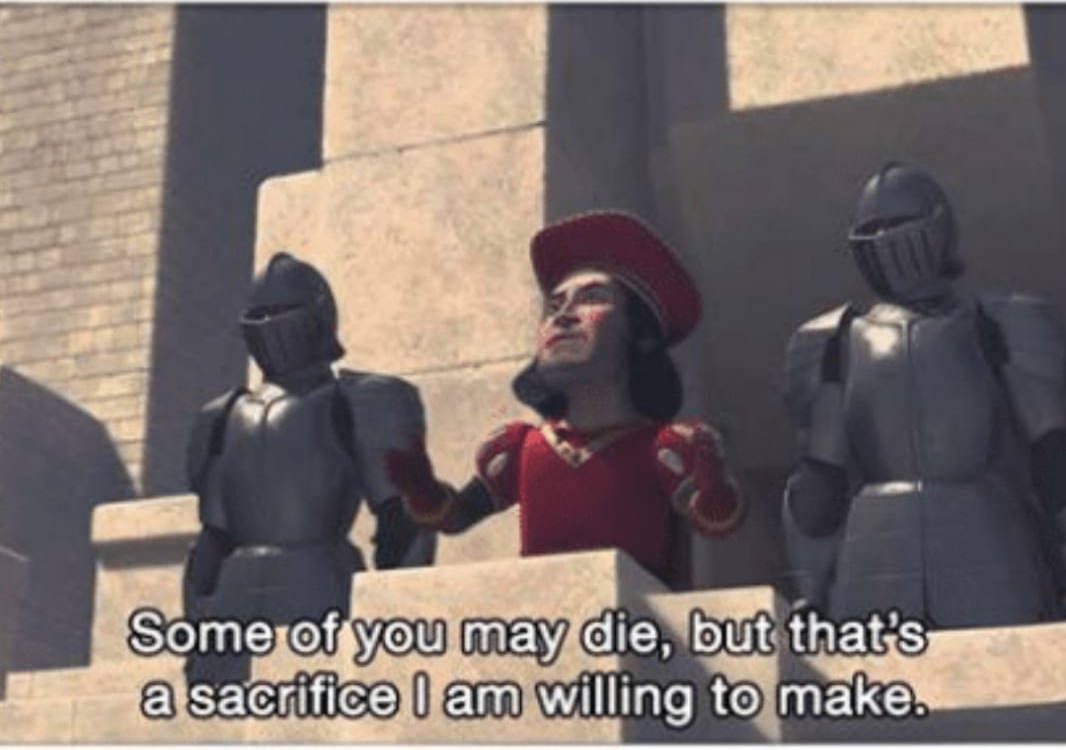
One of the funniest things my dad ever did during one of our many political arguments was imply that his laissez-faire stance on COVID-19 was just as valid as the much more concerned perspective held by epidemiology experts, because he, too, had read “the charts and graphs and data.”2 Of course, when I asked where those incredibly vague sources had come from, he couldn’t say; he just insisted that he had “done his research” before landing at his conclusion, which, if I’m being honest, was giving Lord Farquaad.
“I’ve done my research” is a common refrain on Reddit, in Twitter/X replies, and in Instagram comments, where people whose perspectives are challenged often default to ambiguous defenses that, if taken at face value, make them out to be properly educated on the topic at hand. At this point, it’s a thought-terminating cliché: Whether the commenter is genuinely attempting to engage in conversation or just trying to get someone off their back, “I’ve done my research” (or any of its variations) doesn’t provide room for meaningful discourse. Instead, it places the critic and the person playing defense on artificially equal footing, even if the former has far more reliable sources than the latter. If the critic attempts to dig into where the other person got their “research” (and god help them if they do), the conversation is no longer about its original topic. Instead, it’s about credibility.
I’m not saying anyone who ever says anything online should be prepared to cite every single one of their sources and be able to explain why those sources are legitimate. If this were the case, discourse would begin from an even more defensive angle than it does already. At the same time, though, it’s dangerous to pretend that everyone’s input is equally valuable because everyone’s sources must, by default, be equally authentic.
But what makes an authentic or dependable source? Does formal education inherently trump lived experience every time? Of course not. This assumption would be dangerous, too: Think of all the medical discrimination patients have experienced without proper documentation, the police brutality that goes uninvestigated, or the Indigenous botanical wisdom passed down orally for generations before the advent of Western science. Powerful people or demographics can and do prevent certain phenomena from being formalized in an effort to maintain their power. For this reason (and others), formality and legitimacy may often correlate, but they’re far from mutually exclusive. Lived experience has value, too.
For this reason, it’s important that everyone has the opportunity to share their opinions and experiences freely. The problem is that too many people present their opinions with a flourish of finality, probably to drive engagement and maybe also to feed their own egos. I can’t exactly blame them for craving clicks or confidence, but I can condemn the irresponsible way in which they chase both.
“It’s unsurprising that people are disinterested in being told how to improve or optimize themselves when many of them are only trying to survive,” Mikala Jamison writes in her recent Substack post, You’d be a better person if you exercised more. (Ironically, this title also conveys a bare-faced generalization that quite literally cannot always be true, which is a bummer. A lot of people actually manage to suck more by working out more.)
Maybe this, too, is why the proliferation of posts like these rubs me the wrong way. The internet can be a fantastic place to seek community and learn new things, but being bombarded with accusations about how you’re probably screwing up left and right doesn’t exactly make it a welcoming space in which people feel that their own unique experiences have value.
So, if this bugs you, too: What can we do? We can keep in mind that a vast majority of the posts found on social media, YouTube, forums, and blogs/newsletters are extremely subjective and designed to be taken at face value. (It’s a whole lot easier to look convincing online than it is to make a bold claim in person, where you have to face people’s dubious expressions and real-time follow-up questions.) We can actively look for reputable sources or signs of lived experience, especially when a post makes massive generalizations, claims to predict the future, or has an air of finality. And we can keep an eye on our own online behavior, including our social media comments and blog post titles, to ensure that we aren’t presenting ourselves as experts (or the end-all, be-all voice on a particular subject) when that isn’t what we are. Confidence is one thing; arrogance is another.
When I told my friend I was writing this post, she joked, “I’m not an expert, I just play one on the internet.” What a perfectly concise way to summarize my beef. Saylor, if you ever read this: You can write the next one.

What’s been inspiring me lately:
✰ Hilary Leichter’s novel Temporary3, which hilariously (but also heartbreakingly?!) documents the life of a woman who takes increasingly ridiculous temp jobs in search of “the steadiness.” She has a zillion boyfriends, whom she calls “my culinary boyfriend,” “my tall boyfriend,” “my real estate boyfriend,” and so on. Truly an original concept.
✰ Jenny Slate’s second book of dreamlike essays, Lifeform. I love Jenny Slate and adored Little Weirds, and while her first book is definitely my favorite of the two, the writing in this one was so gorgeous, and her sense of gratitude and whimsy has infected my subconscience.
✰ This cool idea from Phoebe Thompson:
Actually, I like this one. ™™™™™ ©©©©©© (Just covering my bases here.)
My partner and I now quote him on the regular: “Don’t worry. I’ve read the charts and graphs and data.”
If you purchase a book through any of my Bookshop.org affiliate links, I’ll earn a small commission at no extra cost to you! You’ll also support indie bookstores in the process. :)
Whispering here...even literary agents who tell you that you are doing it all wrong. Look them up on Publishers Marketplace. The loudest ones have few sales under their belts. The ones who are quiet are busy selling books.
Something interesting I’ve noticed is that when people criticize social media for making us anxious they’re always like, “the beauty standards are out of control! Stop comparing other people’s fake fantastic lives to yours!” But what makes me anxious is exactly what you’re talking about. These kind of subtle grandiose claims. Black and white thinking. And while I know deep down they’re bullshit, once I hear them or read them, my brain kinda always hangs onto them wondering if maybe I AM doing something wrong. I feel overloaded with info and leave social media feeling like I’m supposed to KNOW and DO all kinds of things differently.