

If you're new to journaling, read this
And no, this isn't becoming a journaling blog. I promise!

Warning: Hot takes ahead. (And if you’re surprised that a person can have hot takes about journaling, me too, but here we are. This is thirty.)
For years, journaling has been a fairly laid-back habit of mine. But once upon a time, I felt the way you might currently feel: overwhelmed by stationery options, intimidated by other people’s gorgeous notebooks,1 and confused about how to get started. Suddenly, what was meant to be a cleansing activity was stressful and complex. Wasn’t journaling supposed to be an intimately personal affair? And if so, why was I so worried about being a bit messy at first?
When I bring up journaling with other people—as I frequently do, because it’s one of my favorite analog hobbies, coping mechanisms, and archival approaches—they often express that they’d like to try journaling, if not for a halting hesitation that borders on dread. They don’t know where to start, for one, but they’re also afraid of where they’ll end up. What if they can’t think of something to write? Or worse: What if the journaling experience makes them feel bad about themselves, when all they really wanted was a way to make peace with their lives?
Distilled here is the advice I, a veteran journaler, have dished out to friends and strangers at coffee shops (yes, really) over the years. If you have been thinking about journaling and don’t know where to start, or you’ve written a few entries but don’t feel like you’re “doing it right,” this is for you.
But before we begin: There is no “wrong” way to journal. There are just easy ways and difficult ways. This, I hope, is one of the former.

1. Start with the most open-ended journal or notebook you can find.
Stationery companies looove to create wellness journals, gratitude journals, question-a-day journals, reading journals, travel journals, financial journals, small-business journals, novel-planning journals, et cetera, because it helps them sell more crap. Oh, you say, browsing their 36-page website,2 I’d love to have a health journal in addition to my dream journal and workout journal and my planner—surely this will make my life more organized.
Those who have journaled and otherwise kept personal records for a long time might have a multi-book approach that works for their unique lives and cognitive needs, but the last thing you need as a beginner is complete and utter overwhelm. Start with one notebook with regular ol’ blank, lined, or grid pages.3 Don’t fret yet over whether the journal’s got a hard or soft cover, a lay-flat binding, a built-in elastic band or pen loop, an inner pocket, or whatever else. You will organically figure out which features you need as you use your first journal, and worrying about these details early on will only stress you out.
2. Don’t worry about having a “system.”
It’s tempting to crack open your brand-new journal and commit to some sort of system in which you create beautiful, multicolored headers for each day or use increasingly obscure symbols to label the components of every entry. While I admire your spirit, this is going to burn you out real quick.
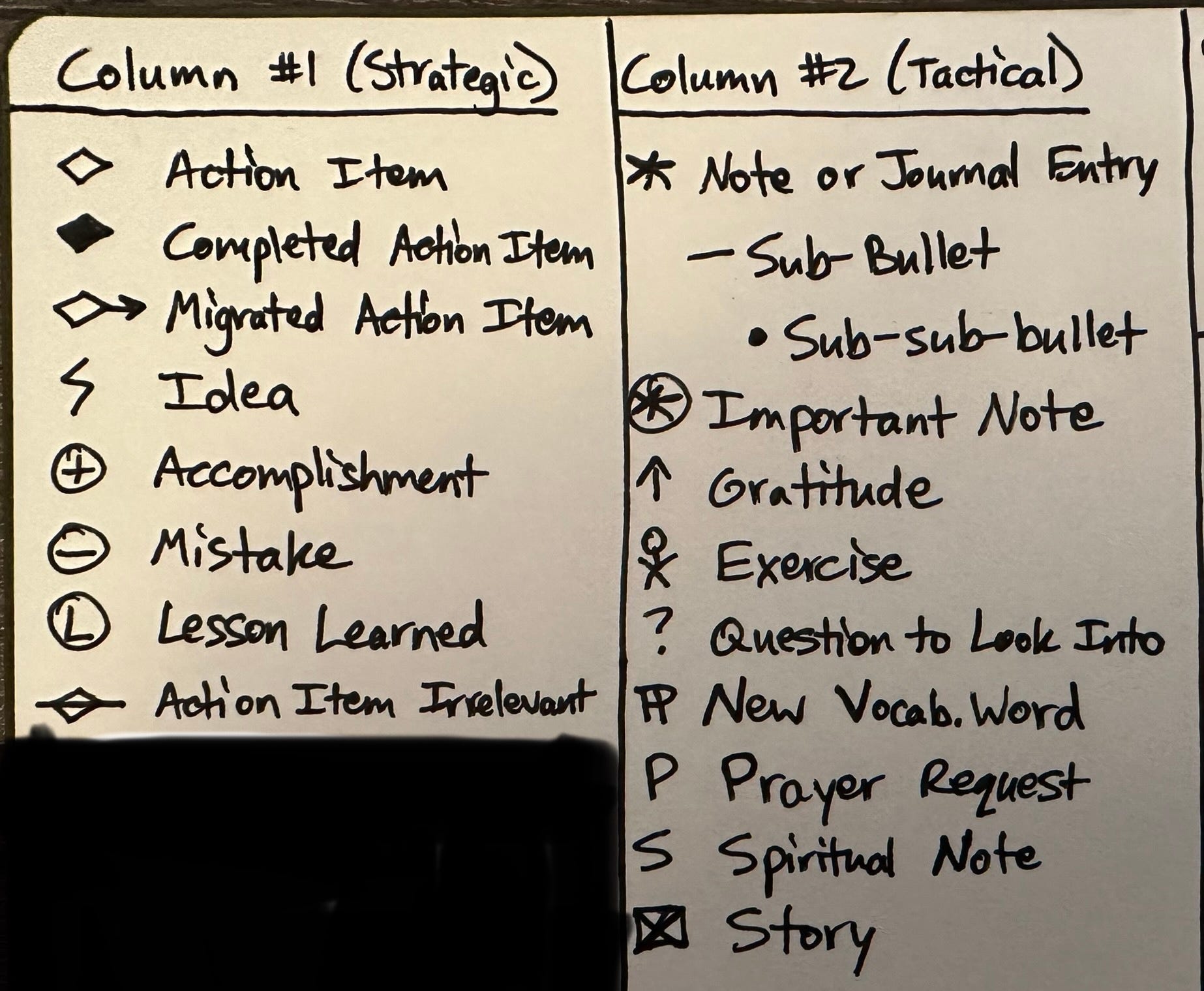
If you commit to anything at all, make it consistency. The more you do an activity, the faster it becomes a habit, and unlike biting your nails or flossing every night, this is a habit you can actually look forward to. Otherwise, though, try to take a very loose approach at first. Try stream-of-consciousness journaling—literally just jotting down whatever pops up in your head as it arrives—or writing a few sentences about what you did today, what’s been on your mind, and what you hope to do tomorrow.
You’re feeling things out, here, like a kid at the shallow end of the pool. If you try to dive into the deep end, you’re gonna bump your head.
3. Don’t try to make it pretty.
Don’t get me wrong; I enjoy seeing people’s gorgeous junk journals, looping cursive, and on-the-go sketches. But journals aren’t inherently for showing off, and I think the inundation of “pretty” journal spreads on Pinterest, Instagram, and Substack can make beginners feel that their own scrappy pages are insufficient or are somehow missing the mark.


The reality is that the aesthetically pleasing spreads you see online are the exception, not the rule, and many of the folks who post those images are going out of their way to assemble pages worthy of showing other people. While I’m not here to yuck their yum, this is a dangerous approach for the average journaler to adopt: When you start opening your journal with an audience in mind, you’re less likely to be honest with the page about what you’re thinking or what you need.
There is a difference between scrapbooking and journaling. When you’re first starting out, I recommend keeping these two activities distinct from one another.
On that note…
4. Don’t be precious about it.
To this day, I’m sometimes hesitant to jot down my first journal entry until it’s “worthy” of kicking off a brand-new notebook. (I’m also weirdly superstitious about the first entry centering on anger or sadness because I worry it means I’ll be angry or sad until I finish the journal, but that’s my own problem.) I want to have something fascinating to report or a brilliant creative idea to record, so that…what? If an archaeologist digs it up in hundreds of years, they’ll think I’m a genius?
Try not to let conceit get in the way of allowing you to spill your guts (or just the highlights of your day) on the page. You’re going to have revelatory entries and stupid ones; it’s just how journaling goes. You might as well just get started.
5. Decide ahead of time what you’ll do with your journal when it’s full.
I love my journals for what they’ve given me, and I’m fortunate to live with someone I trust, so I shelve my completed journals together in my home office once I’m done carrying them around. But others prefer to shred, burn, or recycle the pages of their journals. Knowing that their entries won’t exist in perpetuity gives them the confidence to journal truthfully.
If one of your primary concerns with journaling is keeping a record of your life, designate a spot on your bookshelf, a box under your bed, or a place in your water/fireproof safe for completed notebooks. But if privacy is an issue, planning to dispose of that record could make the difference between journaling self-consciously and journaling freely.
6. Remember that journaling is a habit that gets more fun and rewarding the longer you do it.
Sometimes, I compare journaling (and creative writing, actually) with going to the gym. When you first start exercising, it feels unnatural: It takes a lot of effort; you’re sweating; you don’t really know what you’re doing; and afterward, your body hurts. You look around and wonder how all the people around you (who have undoubtedly been doing this for years) are “better” at this than you. Worst of all, you have to keep showing up if you want to see results.
Journaling can be the same way. It takes time out of your busy day; you might not know what to write at first; everyone else’s journals look better than yours; and afterward—if you get really deep with it—you might have to contend with some messy emotions.
But like going to the gym, if you’ll continue to indulge my corny metaphor, doing an amateur job tops not showing up at all. The workout you do is better than the one you don’t and all that, and the more you show up, the quicker it becomes just another part of your daily or weekly routine. Eventually, there are parts of it that you get excited about, and you begin to learn about yourself, including your unique needs, likes, and dislikes in this hobby.
Once you fill out a journal or two (it’ll happen faster than you think!), you might feel the itch to seek out something more specific or personalized. If you like to journal on your lap, you might decide that hardcover notebooks are ideal for you, and if you’re always forgetting a writing utensil, you might want one with a pen loop.4 You might wish to doodle in your journal, making blank pages preferable to lined, dotted, or grid paper. Or maybe you’ll find that prompts would help you journal more effectively, and you’ll sign up for my Postcard Prompts. 😉

Though they once felt intimidating, I now love the endless possibilities journaling offers me. I love knowing that I can “talk to myself” in my journal all dang day if I need to. I love having another quiet, inexpensive, screen-free activity to do before bed or while I wait for a friend to meet me at a coffee shop.5 I love learning that I need a hardcover notebook because I like to journal on my lap, and a built-in pocket for memorabilia waiting to be pasted onto the page. And I love knowing that one day I will flip through all of my journals again and be able to reflect—with fondness, I hope—on how I once processed life.
This habit is only as complicated as you make it. At the beginning, don’t let it be complicated at all.
What’s been inspiring me lately:
✰ In Universes, Emet North’s beautiful, autofictional take on the many-worlds interpretation of quantum mechanics (i.e., alternate universes). I looove grounded stories that incorporate past/future/alternate selves—if you have any recommendations, please drop them in the comments!6
✰ A dip in the Pacific Ocean I enjoyed this week during a very quick trip to California. I don’t think I’d ever gone swimming in the ocean by myself before, and it ended up being a very meaningful experience, due in part to a pelican that kept showing off for me.
✰ The AI Resist List, an evolving online archive of the ways in which people around the world are resisting the implementation of AI in schools, governments, workplaces, and more.
✰ Guillermo Bert’s Techno-Empathy exhibition at the Museum of Latin American Art in Long Beach, CA. I particularly liked his life-sized laser-engraved wood sculptures of Latine migrants and refugees whose roles were essential to community survival at the start of the COVID-19 pandemic.

I’m using “notebook” and “journal” interchangeably here, since they’re pretty much synonymous.
I’m looking at you, Papier.
I understand that, for a variety of reasons, some people find digital journals preferable to paper ones. While I believe that any journaling is better than no journaling, I’d highly encourage you to try a physical notebook first. Not only will this give your eyes a break from the screens you’re probably looking at all day, but research suggests that writing by hand is better at engaging the parts of your brain responsible for memory, cognition, learning, and creativity.
You can also buy these separately and stick them onto the inner back cover of your journal-in-progress. Most bookstores and stationery stores carry them. (Please, for the love of all things readerly, look there before you check Amazon.)
Sometimes I even journal with my friends. Yippee!
As always, if you purchase a book through my Bookshop affiliate link, I’ll earn a tiny commission at no extra cost to you.
My best friend and I used to have journal picnics. We’d hit the corner market and get a bunch of food, then spend the day just eating and writing together. We’d make up prompts and then have fun seeing how we each interpreted it, we’d pass our notebooks back and forth and write messages to each other to be read later. It doesn’t have to be so solitary and serious all the time! Loved this post.
Inspiring!!!